Your body is not failing: it needs a complete perspective
Fatigue, weight changes, irregular sleep or brain fog can appear together and should not always be analysed separately. At SHOMMA we take an integrative, personalised view of women's health.
When your test results come back “normal” but something still feels off, the problem is rarely you: it may be looking at each symptom separately.
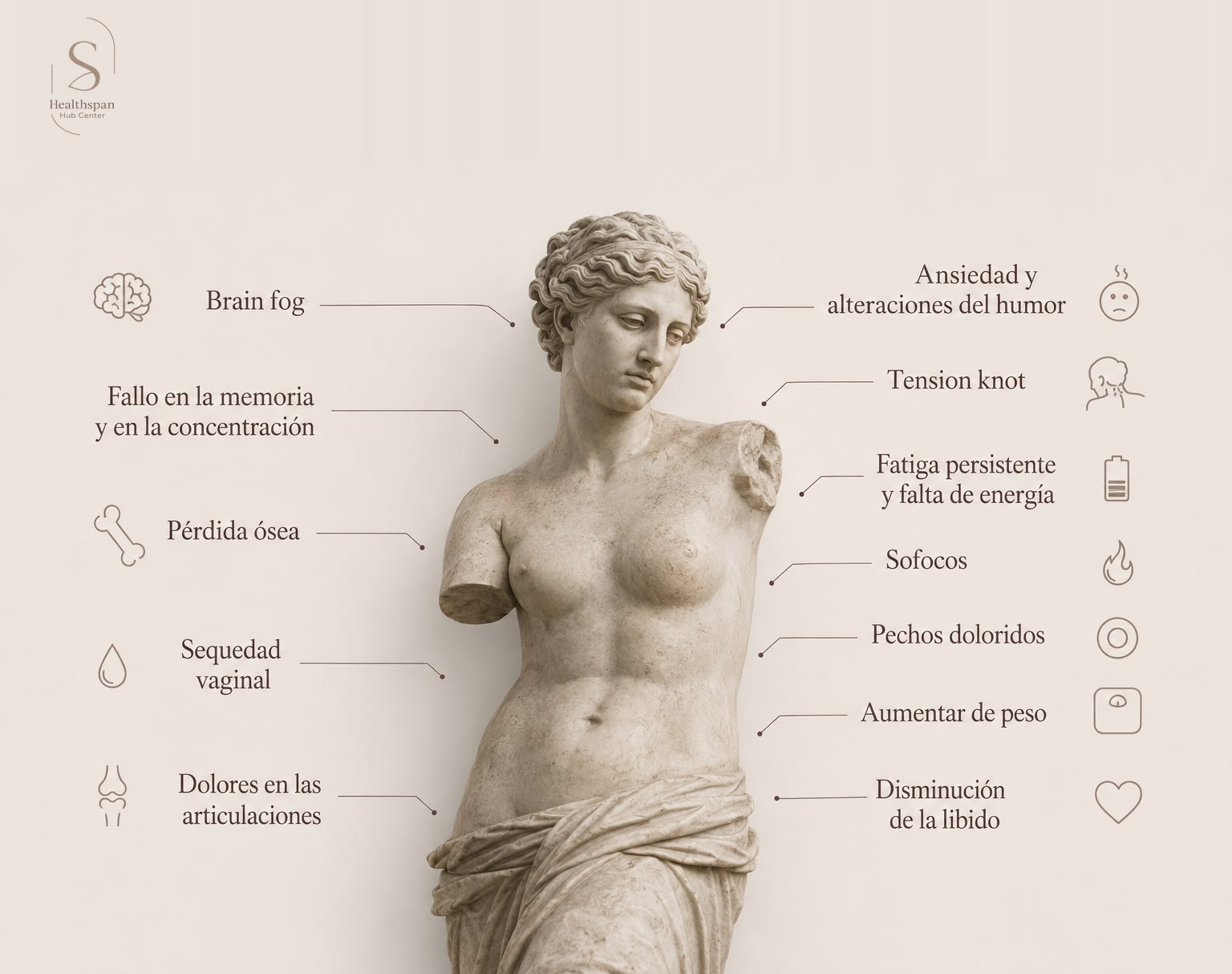
Fatigue. Weight changes. Irregular sleep. Brain fog. Mood changes.
On their own, each one can seem minor. Something to put up with. Something that comes with age.
But what happens when several appear at once?
Perhaps you do not need to get used to feeling this way. Perhaps you need to look at the whole picture.
The scattered symptoms nobody connects
There are moments when you know something has changed, even if you cannot point to exactly what.
- You sleep worse.
- You find it hard to concentrate.
- You have less energy during the day.
- Your body responds differently to exercise or food.
- Your weight changes without major changes in your habits.
- Your mood fluctuates.
And when you talk about it, you often get isolated answers: it must be stress, it must be your age, you need more sleep, exercise more, your results are fine.
But the body does not work in independent departments.
Sleep influences how you feel. Hormones relate to many bodily functions. Metabolism, stress, nutrition, physical activity and rest are part of one same system.
So when several small changes appear at the same time, it may be more useful to stop asking “what do I have?” and start asking: what is my body trying to tell me?
Why does conventional medicine look at parts?
Conventional medicine is essential to diagnose and treat disease. But when we talk about wellbeing, prevention and changes linked to different life stages, a woman's experience can be more complex than a single lab result.
A value can sit within the reference range and you can still feel that something has changed.
That does not mean a test is useless or that disease is necessarily present. It means an isolated number does not always tell the whole story.
The question can then be different: how do my symptoms, habits, context and biomarkers relate to each other?
That is the difference between observing separate pieces and trying to understand the whole puzzle.
What does a complete perspective mean at SHOMMA?
At SHOMMA we start from a simple idea: your health cannot be understood by looking at a single variable.
That is why we seek to know your context and understand what is happening across the areas that can influence how you feel and how you age.
An integrative perspective can consider aspects such as:
- Your personal and family history.
- Your symptoms and how they have evolved.
- Sleep and rest.
- Nutrition and metabolism.
- Physical activity.
- Stress and wellbeing.
- Hormonal health.
- Different analytical parameters.
- Your habits and lifestyle.
- Your medium and long term health goals.
It is not about running tests for the sake of it. It is about gathering the right information to make better decisions.
Knowing a data point is useful. Understanding what it means within your story can be far more useful.
Understand what is happening in your body
We carry out a full assessment of your hormonal, metabolic and cognitive health and design a personalised plan for you.
I want to know moreIt is not about chasing symptoms. It is about understanding them
When a symptom appears, our usual reaction is to try to remove it: something to sleep, more rest, a diet, some relaxation.
But when several symptoms appear together, it may be time to change the question.
Instead of chasing each symptom individually, we can try to understand what lies behind the whole. This is where personalisation matters.
There is no single way to go through menopause, manage stress, maintain muscle mass, sleep well or care for long term health.
Your body has a story. And that story deserves to be heard.
What if your results are “fine”?
This is one of the most frustrating questions: “they tell me everything is fine, but I do not feel fine”.
A result within a reference range does not automatically mean every dimension of your health is optimised.
Laboratory ranges have a clinical function and must always be interpreted by healthcare professionals within the right context.
That is why at SHOMMA we do not interpret a result in isolation, nor turn every variation into a problem. We look for something different: putting data into context.
Information makes sense when it relates to your story, your symptoms, your habits and your goals.
How to start: a Personalised Orientation Session
You do not need to arrive with a diagnosis, or know exactly which test you need, or have all the answers.
You can simply start by explaining how you feel and what has changed.
In a Personalised Orientation Session, the goal is to organise that information, understand your situation and help you identify which aspects may be relevant to assess your health more completely.
From there, the team can guide you on next steps and, where appropriate, on which assessments may provide useful information.
Because the first step is not always to do more. Sometimes it is to start looking better.
Your body is not failing
Perhaps you have been saying for months: I am not who I used to be, it must be my age, this must be normal, I have to get used to it.
But normalising something does not necessarily mean resigning yourself to it.
Your body changes. And understanding those changes can help you make better decisions about your health.
At SHOMMA we want to help you stop seeing symptoms as isolated pieces and start building a more complete view of your health.
Because it is not simply about living more years. It is about living them with more health, energy and autonomy.
Do you feel something has changed but you are not sure what? Start by understanding your body from a more complete and personalised perspective. Book a Personalised Orientation Session.
Understand what is happening in your body
We carry out a full assessment of your hormonal, metabolic and cognitive health and design a personalised plan for you.
I want to know moreStart understanding your own healthspan
An initial Assessment with our medical team at Our Centre to establish your baseline.