What you think about ageing matters too: the science of age beliefs.
What we think about age is also part of our health. Beatriz Mayoral explores the science of age beliefs, menopause and healthspan, without confusing associations with causes.
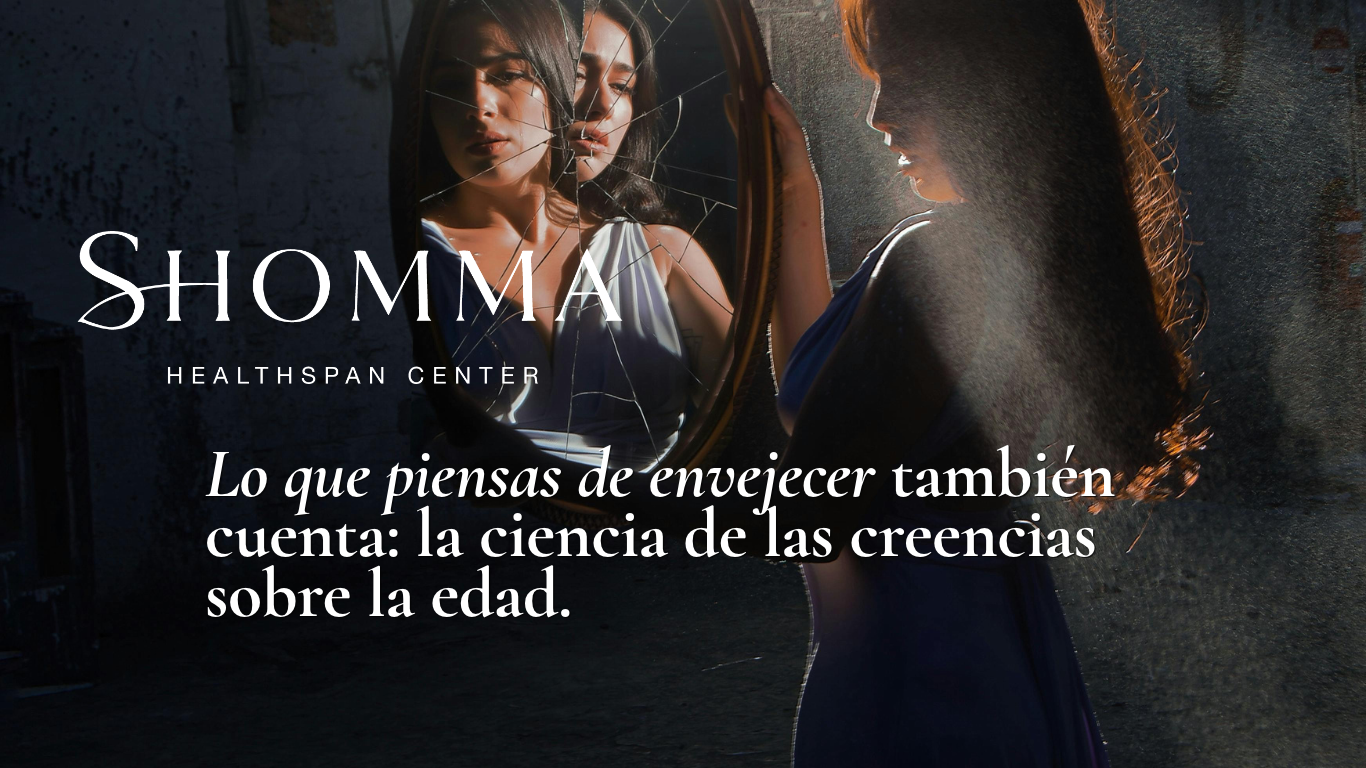
What words come to mind when you think of a 70-year-old woman? Active, wise, free? Or frail, tired, forgetful?
It may seem an unimportant question, but scientific research has spent decades studying how our beliefs about ageing relate to our health, independence and life expectancy.
At SHOMMA, one idea is part of how we understand health: mind and body do not function separately. What we think and feel influences how we live, our habits and how we face the changes that come with time.
And this also has a biological dimension.
Can your understanding of ageing influence how long you live?
One of the best-known studies on this subject was published in 2002 by a Yale University team led by psychologist Becca Levy.
The research followed 660 people over 50. Decades earlier, participants had answered questions about their own perceptions of ageing, including statements such as ‘as I get older, I am less useful’.
When the researchers compared those answers with mortality records, they found a striking result: people with more positive perceptions of their own ageing lived, on average, 7.5 years longer than those with more negative perceptions.
The association remained after considering factors such as age, sex, socioeconomic status, loneliness and functional health.
This finding invites us to broaden the conversation about longevity: not only how long we live, but also how we interpret and experience the passage of time.
Longevity and healthspan: more than adding years
At SHOMMA, we talk about healthspan: the years we live with health, independence and quality of life.
Research into age beliefs has also found associations with important aspects of this journey.
Functional recovery
In a follow-up of people over 70, those with more positive views of ageing were 44% more likely to recover fully from severe disability. This means regaining everyday activities such as bathing, dressing, getting up from a chair or walking without help.
Brain health
In 2018, a study followed 4,765 people with an average age of 72 and no dementia at the start for four years. Among those with the APOE ε4 genetic variant, associated with greater dementia risk, the observed risk was 2.7% in people with positive age beliefs, compared with 6.1% in those with negative beliefs.
These results do not mean that attitude can override genetics or guarantee healthy ageing. They show that biology and psychological and social factors deserve to be studied together.
Menopause: how we experience this stage matters
For many women, menopause is one of the first moments when ageing stops being an abstract idea and becomes a personal experience.
Hormonal changes, hot flushes, sleep disturbances and mood changes can transform how a woman feels and relates to her body.
A systematic review published in Maturitas analysed 13 studies on attitudes towards menopause and symptom experience. Ten found that women with more negative attitudes reported more symptoms during the transition; three found no significant relationship.
These findings require careful interpretation: symptoms are not ‘all in your head’. They have a real biological basis and deserve professional attention and support.
The research suggests that how we interpret this stage may also form part of our experience. And that perspective can be explored and worked on.
What connects mind, hormones and body?
From the perspective of psychoneuroimmunoendocrinology (PNIE), the nervous system, hormones, immune system and psychological processes communicate constantly.
Beliefs held over time can influence our stress response, our sense of self-efficacy and the decisions we make about our health.
Researchers have proposed different mechanisms to explain the observed associations: a lower cardiovascular response to stress, better physical balance, greater confidence in our ability to act and a greater presence of healthy habits.
Many of our beliefs about age are also formed in childhood. We absorb them from our surroundings, cultural messages, advertising and the models of ageing we see around us.
Understand what is happening in your body
We carry out a full assessment of your hormonal, metabolic and cognitive health and design a personalised plan for you.
We are not always aware of them.
Changing the conversation about age can therefore also change our relationship with our own body.
Three ways to begin transforming your relationship with age
This is not about forcing yourself to think positively or denying difficulties. It is about recognising automatic ideas that may be limiting how you experience this stage.
1. Identify your automatic phrases
‘I am too old for this.’ ‘At my age, feeling like this is normal.’ ‘Every year I get worse.’
Pay attention to the expressions you use when talking about yourself and your body. You can write them down for a week. Recognising them is the first step towards questioning them.
2. Find new role models
Look at women of different ages who live this stage with energy, independence, curiosity and purpose. Broadening our role models helps us question age-related stereotypes.
3. Question cultural messages
When you hear that ageing is something to fight, ask yourself what image of age that message conveys. Ageing is not a disease. It is a natural process that deserves understanding and support.
How we work with this dimension at SHOMMA
At SHOMMA, we believe women's health needs an integrative perspective. Psychological wellbeing is therefore part of our approach to health and longevity.
Within the 360° Diagnosis, an Integrative Psychology session explores sleep, stress, emotional experience and how each woman experiences her stage of life.
This information is brought together with assessments from different disciplines to build a personalised six-month plan.
Because caring for healthspan also means paying attention to our history, our emotions and our relationship with ourselves.
Ageing is not a problem to solve
Age should not define what a woman can do, feel, learn or enjoy.
Science invites us to look at ageing from a broader perspective, where biological, psychological and social factors are part of the same conversation.
It is not about denying the passage of time. It is about living it with information, independence and a kinder view of ourselves.
Because what you think is also part of your health.
SHOMMA Healthspan Center. The future of longevity is female.
Discover the SHOMMA Method or contact our team to explore how we can support you at your stage of life.
Scientific references
Levy, B. R., Slade, M. D., Kunkel, S. R., & Kasl, S. V. (2002). Longevity increased by positive self-perceptions of aging. Journal of Personality and Social Psychology, 83(2), 261–270. https://doi.org/10.1037/0022-3514.83.2.261
Levy, B. R., Slade, M. D., Murphy, T. E., & Gill, T. M. (2012). Association between positive age stereotypes and recovery from disability in older persons. JAMA, 308(19), 1972–1973. https://doi.org/10.1001/jama.2012.14541
Levy, B. R., Slade, M. D., Pietrzak, R. H., & Ferrucci, L. (2018). Positive age beliefs protect against dementia even among elders with high-risk gene. PLoS ONE, 13(2), e0191004. https://doi.org/10.1371/journal.pone.0191004
Ayers, B., Forshaw, M., & Hunter, M. S. (2010). The impact of attitudes towards the menopause on women’s symptom experience: A systematic review. Maturitas, 65(1), 28–36. https://doi.org/10.1016/j.maturitas.2009.10.016
Understand what is happening in your body
We carry out a full assessment of your hormonal, metabolic and cognitive health and design a personalised plan for you.
Start understanding your own healthspan
An initial Assessment with our medical team at Our Centre to establish your baseline.