Genetics and muscle mass: how to keep your strength as you age
Discover how genetics, hormones and menopause influence muscle health, and why strength training is key to healthy longevity.
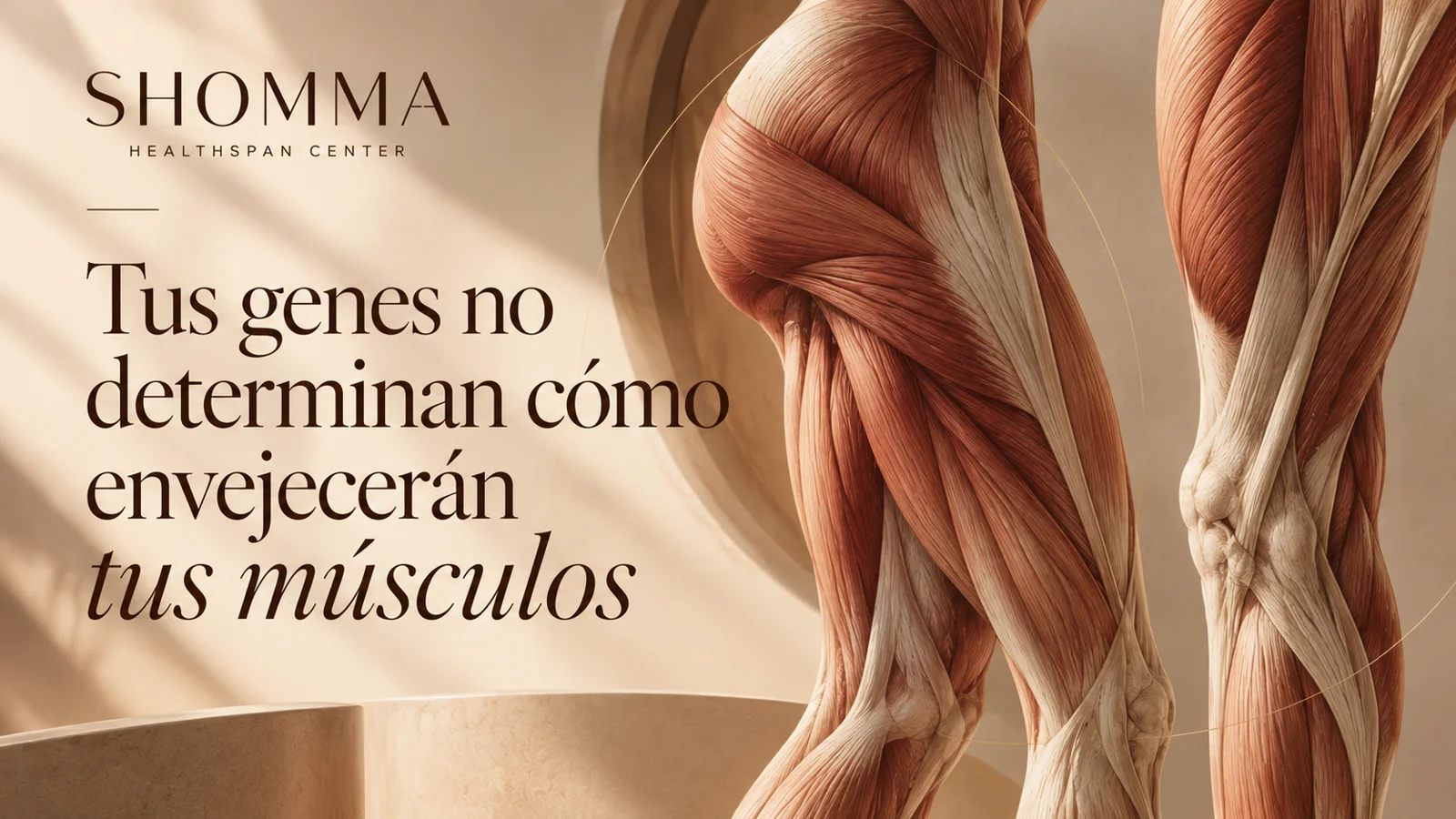
Genetics influences our muscle health, but it does not on its own determine how our strength and muscle mass will evolve. Understanding which factors we can change is essential to protect autonomy, mobility and longevity.
Why can two women of the same age have such different strength, body composition and physical capacity?
The answer lies not only in their age or their genes. Physical activity, nutrition, rest, health status, environment and hormonal changes also influence how our body maintains muscle throughout life.
At SHOMMA we see muscle health as an essential part of women's health and healthy longevity. Because it is not only about how we look, but about how we move, which capacities we keep and how we want to live the years ahead.
How does genetics influence muscle mass?
Genetics helps explain some differences between people in traits such as strength, muscle power, body composition and response to exercise.
However, there is no single gene that determines whether a person will develop sarcopenia or lose muscle with age.
Research has identified genetic variants related to different aspects of muscle function. Among the genes studied is ACTN3, linked to a protein found in fast-twitch muscle fibres and to certain strength and power characteristics.
But finding a genetic association does not mean we can accurately predict a person's muscular future. Current findings still have limitations and must be interpreted with caution.
In other words, genes can tell us something about our biology, but they do not tell the whole story.
What is sarcopenia and why should we pay attention?
Sarcopenia is a muscle disease characterised by a decline in strength and in the quantity or quality of muscle. It can affect mobility, increase the risk of falls and make everyday activities harder that we once did effortlessly.
Although it is more common at older ages, caring for muscle health should not start when a physical limitation appears. Strength and muscle function are built and maintained throughout life.
Moreover, low muscle mass alone is not enough to diagnose sarcopenia. The European consensus EWGSOP2 considers low muscle strength a key early sign and also requires assessing muscle quantity or quality to confirm the diagnosis.
That is why, rather than waiting to notice a major loss of physical capacity, it is worth paying attention to our strength, our movement and how they evolve over time.
Is muscle loss during menopause related to hormones?
The transition to menopause is an important stage to review muscle health.
Hormonal changes, including those related to oestrogens, may be accompanied by changes in body composition and muscle function. Research is studying how these hormones take part in muscle ageing, although results do not yet allow all muscle changes to be attributed exclusively to them.
Menopause does not mean that every woman will develop sarcopenia either.
What matters is understanding that each woman reaches this stage with a different story: habits, fitness, health history, activity level and individual needs.
So it can be a good moment to review physical activity, strength, nutrition and other factors that help maintain muscle function.
Menopause need not mark the start of an inevitable loss of capacities. It is an opportunity to pay attention to present and future health.
Strength training: a key tool for women's longevity
Although we cannot choose our genes, we can work on many of the factors that influence muscle health.
Understand what is happening in your body
We carry out a full assessment of your hormonal, metabolic and cognitive health and design a personalised plan for you.
I want to know moreStrength training, adapted to each person's abilities and needs, helps maintain or improve strength and muscle mass. Evidence also supports the benefits of exercise in midlife women, including those going through the menopausal transition.
Caring for muscle goes far beyond aesthetics.
Strength lets us get up from a chair, climb stairs, carry things, keep our balance and react to a stumble. It also helps preserve independence and the ability to cope with periods of inactivity or illness.
That is why including strength exercises in a routine adapted to each woman can be an important investment in her long-term health.
There is no single routine that suits everyone. The choice of exercise, its intensity and progression should take into account fitness, previous experience, goals and any health limitations.
Can a genetic test predict whether you will lose muscle?
Currently, a genetic test cannot reliably predict whether a person will develop sarcopenia, when it might appear or how much muscle loss there would be.
Nor does it replace assessing strength, physical function or, when indicated, muscle quantity or quality.
Genetic information can help investigate biological mechanisms and certain predispositions, but it should not be mistaken for a diagnosis or a definitive individual prediction.
In practice, it is usually more useful to know our starting point: how strong we are, how we move, how active we are and which capacities we want to preserve.
That information makes it possible to set concrete goals, adapt recommendations and track our progress over time.
An integrated view of muscle health at SHOMMA
At SHOMMA we understand that every woman has a different story, physical condition and goals.
That is why our philosophy starts with an individual assessment that helps us understand each person's context and guide decisions about her health.
Strength is an important piece within a broader view that includes movement, habits, life stage and individual priorities.
It is not about labelling a woman by her results or applying a universal recipe. It is about identifying which capacities to develop, which areas need attention and how to move forward in a realistic, sustainable way.
Because longevity is not only about living more years. It is also about keeping, for as long as possible, the ability to move, decide and enjoy our lives with autonomy.
Today's strength is also part of your future health
We cannot choose our genes, but we can act on many of the factors that influence how our muscles age.
Understanding our muscle health, staying active and adapting exercise to our needs are steps that can contribute to a life with more strength, mobility and autonomy.
Ageing does not mean giving up our capacities. It means understanding what we need to care for them.
At SHOMMA we believe in medicine that looks beyond symptoms and supports every woman in making informed decisions about her health at every stage of life.
Scientific references
- Genetic Patterns Related with the Development and Progression of Sarcopenia and Sarcopenic Obesity: A Systematic Review. Medicina. 2025;61(5):866. https://doi.org/10.3390/medicina61050866
- Cruz-Jentoft AJ, et al. Sarcopenia: revised European consensus on definition and diagnosis (EWGSOP2). Age and Ageing. 2019;48(1):16–31. https://doi.org/10.1093/ageing/afy169
- The role of estrogen in female skeletal muscle aging: A systematic review. Maturitas. 2023. https://doi.org/10.1016/j.maturitas.2023.05.006
- Effect of non-pharmacological interventions on the prevention of sarcopenia in menopausal women: a systematic review and meta-analysis of randomized controlled trials. BMC Women’s Health. 2023;23:594. https://doi.org/10.1186/s12905-023-02749-7
Understand what is happening in your body
We carry out a full assessment of your hormonal, metabolic and cognitive health and design a personalised plan for you.
I want to know moreStart understanding your own healthspan
An initial Assessment with our medical team at Our Centre to establish your baseline.